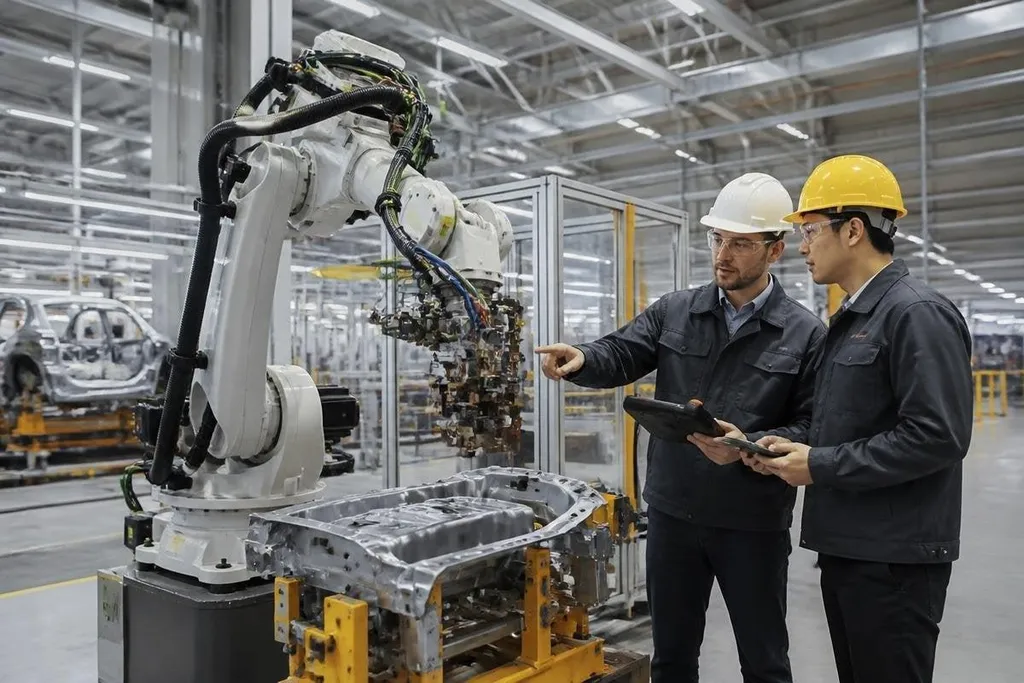
A vehicle factory can buy a robot arm, but the larger business may sit around that arm.
Companies can earn money from installation, software, safety checks, maintenance, training, and parts that keep automated work running.
For an operator deciding where to invest, the useful question is clear: which job can a robot do often enough to justify support around it?
- Sell the setup: connect robots to tools, sensors, conveyors, and factory software.
- Charge for uptime: handle service, spare parts, repairs, and remote help.
- Build for one task: focus on welding, painting, inspection, material movement, or another repeatable job.
Where the work starts
Automotive robots already fit tasks with fixed paths and repeatable motions. The arm can move a part to a jig, weld a seam, apply paint, or inspect a surface with a camera. Each task needs different tools, software, safety checks, and worker training.
That creates room for specialist companies. A small firm may not build the robot arm, yet it can build the gripper that holds a door panel, the vision system that checks a weld, or the software that sends a failed part to a human inspector.
The customer usually buys an outcome: a working station that can run safely and connect to the rest of the line. The supplier earns its place by making that station work inside a real plant, where old machines and new software must share data.
Service can last longer than the sale
The sale happens once. Maintenance returns as long as the cell runs. Motors wear, cables bend, cameras lose their position, and tools need new settings when a vehicle design changes.
That gives service companies several ways to charge. They can sell scheduled inspections, keep spare parts nearby, train plant technicians, or provide remote fault checks. The work becomes easier to price when the supplier knows the robot model, the task, and the number of operating hours.
Training is another practical opening. A plant needs people who can set up a task, read an alarm, change a tool, and stop the cell safely. A course built around one robot brand and one production task may help more than a broad class with little time on the actual equipment.
Software has to connect old and new
A factory rarely replaces every machine at once. New robot cells must often share signals with conveyors, presses, databases, and safety systems already in place. That makes integration work a direct business need.
A software supplier might collect cycle data, show fault codes, or send inspection results to a quality system. The useful product is the part that cuts manual data entry and helps a technician find the failed step faster. Claims about savings need plant records, not a polished demo.
A body shop can see a clean weld in a demo and still need the task, plant, date, and result before pricing the system. Robot24.com can place those facts beside the reported machine and company, leading into the hard parts buyers will test.
The hard parts buyers will test
Automotive work is demanding. A service provider must handle safety rules, production stops, tool changes, and the cost of a bad part. One that works in a short demo may still need careful tuning before it can run through a full shift.
The supplier also needs a clear limit. A camera inspection system may check one surface under fixed lighting, yet struggle when glare, dust, or part position changes. Saying where the system works saves the buyer a costly trial and gives the supplier a better chance of winning repeat work.
I'd start with service around one proven task before building a wide product range. That route keeps the first sale close to a real factory problem and gives the supplier useful data for the next installation.
A practical buying checklist
Before funding an automotive robotics business, check these points:
- Name the task: write down the part, tool, motion, and person who handles the work today.
- Measure the loss: record stoppage time, rejected parts, labor hours, and repair costs before making a savings claim.
- Set the boundary: state the materials, lighting, speed, payload, and part positions the system can handle.
- Plan the handoff: decide who fixes faults, replaces parts, and approves changes on the factory floor.
- Price the service: include installation, training, software updates, spare parts, and support after the first sale.
The strongest business may be the one that keeps a robot cell useful after installation. A supplier that can prove task results, service time, and repair cost has a better case for the next factory order.